
You want to know whether collagen gummies work before you spend money on another jar. Straight answer, before anything else: not the way the label leads you to believe, and the reason has nothing to do with the brand you pick.
Collagen is a protein. Digestion takes proteins apart into amino acids and short fragments before any of it reaches your blood, so nothing arrives at your skin as collagen. Your body then builds its own, and for that it needs specific nutrients rather than more collagen in a sweet. On top of that, a gummy is a small object, and the human studies people quote used doses measured in grams.
That sounds like bad news for the whole category. It is not, quite. It just means the question most people ask is the wrong one, and the right question changes which jar you should be looking at.
It is also why the jar we keep coming back to, Gelagen, contains no collagen whatsoever. On a page about collagen gummies that sounds like a strange recommendation, right up until you see what is in there instead: five B-complex nutrients, each named on the label with its exact chemical form, in amounts a gummy can genuinely carry.
You lose an ingredient your stomach was always going to take apart, and you gain a panel you can actually read. That is not a consolation prize. It is the point.
What happens to collagen after you swallow it?
The same thing that happens to a chicken breast.
Collagen is a protein, and your body treats every protein the same way. Stomach acid and enzymes break the long chains into amino acids and short peptides. Only those small pieces cross into your bloodstream. The intact collagen molecule, the thing pictured on the box as a tidy triple helix, does not survive the trip and is not meant to.
From there your body uses those amino acids wherever it decides they are needed, which is a decision your digestive system makes and your marketing does not. There is no delivery address written on them. Swallowing collagen does not put collagen in your face any more than eating muscle builds muscle.

Is there even enough collagen in a gummy to matter?
This is the part the category would rather you did not work out, and it is simple arithmetic about physical space.
The human trials that put collagen peptides on the map used daily doses measured in grams, taken every day for weeks. A gummy is a small sweet. Most of its mass has to be the things that make it a gummy at all: the gelling agent, the sugar or sweetener, the water, the flavour and the colour. What is left over for the active ingredient is a fraction of a small object.
So even setting digestion aside, you would need a serious handful of gummies a day to approach what the research used. Nobody sells it that way, because nobody would buy it.
So what does your body actually use to build collagen?
Your body makes collagen continuously, and the process has requirements. The best documented of them is vitamin C, which is not optional: the enzymes that stabilise new collagen cannot do their job without it. That link is old, settled biochemistry, and it is the reason scurvy damages skin, gums and the healing of wounds.
Alongside that sit the B-complex nutrients involved in how skin cells renew themselves. The National Institutes of Health Office of Dietary Supplements notes in its fact sheet on biotin that a deficiency shows up in the skin, the hair and the nails. That is a statement about what happens when you do not have enough, which is a different and far more honest claim than promising what happens when you take extra.
Read that difference carefully, because the whole category lives in the gap between the two. We say the same thing in our guide to glass skin supplements, and it is the reason we keep coming back to labels rather than to promises.

What should a skin gummy actually contain?
Four questions, and they work on every jar in the aisle, not only the ones we looked at.
- Is every nutrient named, with its chemical form? "B12" is a family. Methylcobalamin and cyanocobalamin are not the same thing, and a label that will not say which one is in there is a label that does not want to be compared
- Is it carrying something that works at gummy scale? Vitamins work in milligrams and micrograms. That fits. Protein does not
- Can you work out the cost per day? Gummies per jar, gummies per serving. Price per jar tells you nothing until you divide
- Is the refund window a number of days? "Satisfaction guaranteed" with no number attached is a sentence, not a guarantee
Most of the shelf fails on the first one alone. We go through the same checks product by product in our guide to Korean beauty supplements.
So where does Gelagen come into this?
Because of what it leaves out.
Gelagen contains no collagen at all. For a page about collagen gummies that sounds like a disqualification, and it is the opposite: it means the maker is not charging you for an ingredient that digestion was going to dismantle anyway. It is a B-complex gummy that is honest about being one.
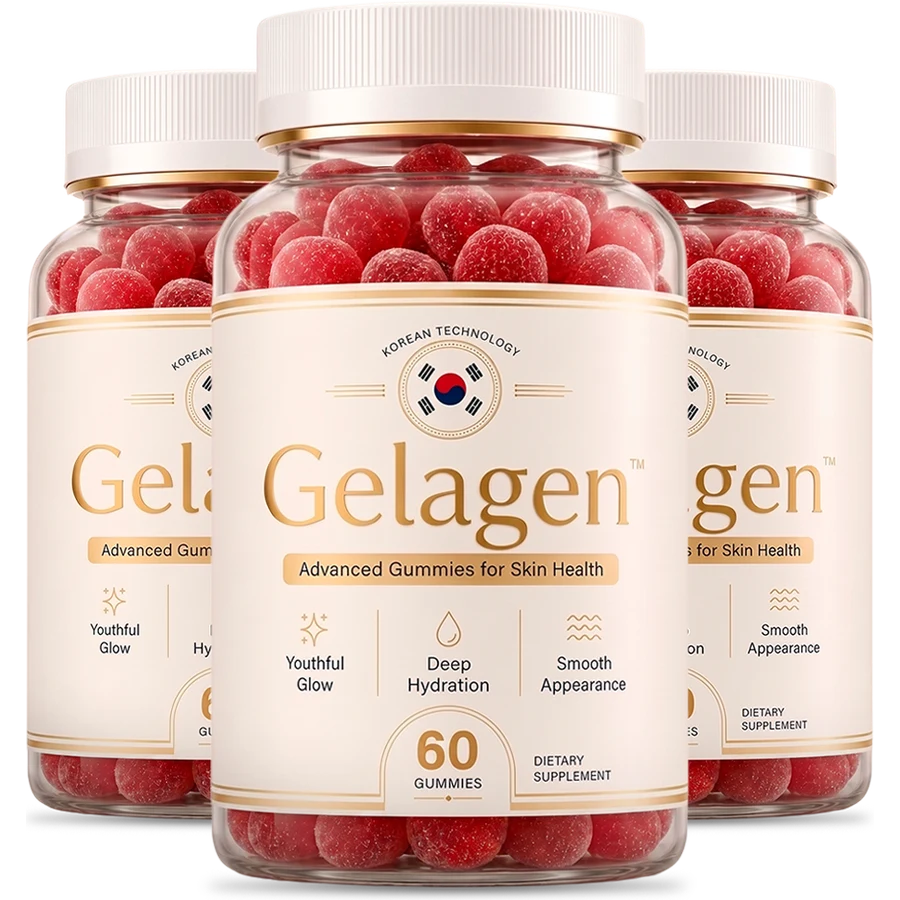
Gelagen Korean Beauty Gummies
- Five B-complex nutrients, each named with its exact chemical form: biotin, B12 as methylcobalamin, B6 as pyridoxine hydrochloride, folate, and pantothenic acid as d-calcium pantothenate. No blend name standing in for the panel
- No collagen, and no pretending otherwise. Nothing in the jar is there to survive your stomach intact
- ⚠ It does not print the milligram amount of each nutrient, only the list. That is our first check, and it is where this label stops short
- 60 gummies per jar, two a day, so a jar is a 30-day supply and the cost per day divides cleanly
- Pectin-set, not gelatin, and the seller says so rather than trading on the word
- 60-day money-back window, written in days on the seller's own checkout page
We are not telling you it is flawless. The missing milligram amounts are a real gap and we say so on every page that mentions it, including our full review of Korean gummies for skin. But between a jar that names what is inside and the exact form of each nutrient, and a jar selling you a protein your stomach will take apart, the comparison is not difficult.
How long before anything changes?
Longer than any label suggests, and this is worth being blunt about before you buy anything.
Skin renews on a cycle measured in weeks. Hair and nails grow slower still. Nothing you swallow shows up in a mirror on Friday, and a product that implies otherwise is telling you what you want to hear.
Two months is a fair period to judge a daily supplement, which is also, conveniently, roughly the length of the refund window on the product above. That is the practical reason we keep pointing at the guarantee instead of at a promise: it is what makes trying something cost you the effort rather than the money.
- Collagen is a protein, and digestion takes proteins apart. Nothing reaches your skin as collagen.
- The studies people quote used grams. A gummy cannot physically carry that much of anything.
- Your body builds its own collagen, and vitamin C is a requirement of that process rather than an optional extra.
- Judge a jar on four questions: every nutrient named with its form, an ingredient that works at gummy scale, a cost per day you can calculate, and a refund window in days.
- Gelagen contains no collagen, names all five of its nutrients and their chemical forms, and gives you 60 days to send it back.
Frequently asked questions
Do collagen gummies work for skin?
Not in the way the packaging implies. Collagen is a protein, and digestion breaks proteins into amino acids and short peptides before absorption, so none of it arrives at your skin as collagen. Your body builds its own collagen from those raw materials, and that process depends on nutrients such as vitamin C rather than on swallowing more collagen.
How much collagen is in a collagen gummy?
Far less than the human trials used. Those studies worked with daily doses measured in grams, and a gummy is a small sweet whose mass is mostly gelling agent, sweetener and water. Any one brand may carry more or less, which is exactly why the amount should be printed on the label and compared before you buy.
Are collagen gummies better than collagen powder?
Powder can physically carry a dose in the gram range and a gummy cannot, so if your goal is to match what the research used, powder is the only one of the two that gets close. Digestion still takes the protein apart either way.
What should I look for instead of collagen?
Nutrients that work at the scale a gummy can actually deliver, named individually with their chemical form. Vitamin C has the clearest role in collagen synthesis, and the B-complex nutrients are the ones most often tied to skin, hair and nails. A label that hides the panel behind a blend name cannot be compared with anything.
Does Gelagen contain collagen?
No, and that is deliberate. It is built on five B-complex nutrients, each named with its exact chemical form, rather than on a protein that digestion would dismantle. It belongs in this conversation because of the goal people are chasing, not because it shares the ingredient.
How long should I give a skin supplement before deciding?
Two months is a fair test. Skin renews on a cycle measured in weeks, and hair and nails are slower again, so a few days tells you nothing. That is also roughly the length of the 60-day refund window on the product we point to, which is what makes the trial cost you the effort rather than the money.
We read the full label, name every source in the text, and check the price on the seller's own checkout page rather than the landing page. We publish no star rating until a category clears 30 independent reports across two or more sources.